Disclosure This post contains affiliate links. As an Amazon Associate, I earn from qualifying purchases at no extra cost to you.
Start Your Day Right: An Easy Tai Chi Morning Routine for Flexibility and Balance
Have you ever stepped out of bed and felt as though your body wasn’t quite ready to start the day? Perhaps your hips feel stiff, your lower back is tight, or your ankles make sounds as you walk your first few steps. Engaging in a morning tai chi routine can provide your body with the gentle awakening it needs to prepare for the day ahead.
Understanding Tai Chi
Tai chi is known for its slow and deliberate movements, designed to enhance flexibility, balance, and relaxation. Each movement is performed thoughtfully and in sync with your breathing, making it accessible to everyone, regardless of fitness level. You don’t need any special equipment; simply wear comfortable clothing and enjoy the practice in a free space.
Research indicates promising benefits of tai chi for various health issues. While most studies monitored individuals with specific conditions who practiced regularly for weeks, the general outlook is positive. For example, according to research from the National Institutes of Health, multiple studies on osteoarthritis suggest that tai chi alleviates pain and reduces stiffness. Notably, the American College of Rheumatology and the Arthritis Foundation highly recommend tai chi for managing knee and hip osteoarthritis. A recent review from 2021 classified the evidence on knee osteoarthritis as low to moderate, hinting at the potential benefits of incorporating tai chi into your daily routine.
Although we lack studies that specifically assess the impact of a brief morning routine, the research emphasizes the importance of consistent practice over time. If you experience prolonged stiffness, swelling, or warmth in any joints each morning, it is advisable to consult a healthcare professional rather than solely relying on an exercise routine.
Ready to begin? This tai chi morning routine can be completed in roughly ten minutes and includes a warm-up phase.
Warm Up: Prepare Your Ankles and Wrists
Start your routine seated at the edge of your bed with your feet flat on the floor.
- Raise one foot slightly and gently draw circles with your ankle, performing five circles in each direction. Switch to the other foot and repeat.
- Next, repeat the process with your wrists, making slow circular movements in both directions.
- Finish off by rolling your shoulders back several times.
This gentle warm-up helps mobilize your joints before putting weight on your feet.
Now, carefully rise to a standing position. If you feel lightheaded, sit back down for a moment until the sensation passes. If lightheadedness is frequent, consider discussing it with your doctor.
1. Wuji Standing with Deep Breathing
Wuji (pronounced “woo-jee”) is a foundational standing posture in tai chi. It creates a moment of mindfulness to connect with your body before you start moving.
Instructions:
- Stand with your feet hip-width apart and toes facing forward.
- Allow your knees to be soft without locking them.
- Imagine your tailbone is heavy, while the crown of your head floats upwards, as though pulled by a string.
- Let your arms hang relaxed at your sides, with space under your armpits, and place one hand on your belly.
- Inhale deeply through your nose, feeling your belly push gently into your hand. Exhale slowly as you feel your belly soften back.
Remain in this position for about one minute. Although it may seem simple, this posture forms the basis of your tai chi practice.
2. Waist Turns with Relaxed Arm Swings
This movement is straightforward but effective in warming up your body.
How to Perform:
- Stand tall in Wuji but with slightly wider feet.
- Gradually turn your waist to the right, allowing your arms to swing easily. Your left hand may lightly brush your belly as your right hand swings behind you.
- Return to the center and turn to the left, mimicking the same swinging action.
- Maintain a slight bend in your knees, keeping your head aligned with your chest.
- Continue this gentle turning motion for 10 to 20 counts.
If you have any back conditions, keep the movements minimal and slow during this exercise.
3. Cloud Hands
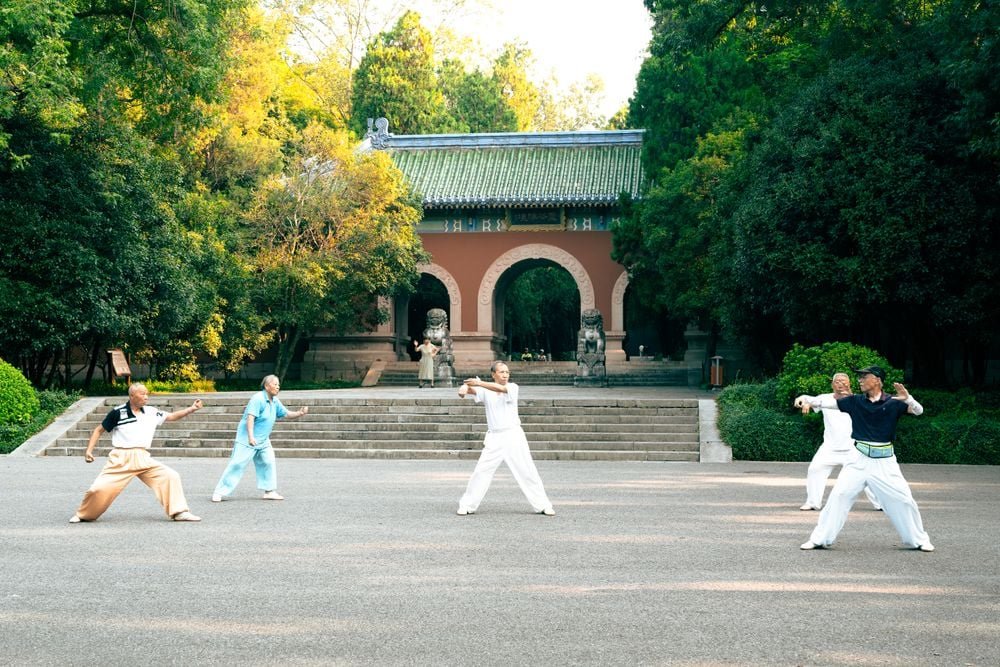
Often recognized by spectators in parks, cloud hands involves a flowing movement as your weight transitions gently between legs.
Execution:
- Stand with your feet about shoulder-width apart and knees relaxed.
- Raise your right hand to chest height, palm inward, while your left hand rests against your belly, palm facing down.
- Slowly twist your waist to the right while allowing your upper hand to follow. Your weight should shift into your right leg.
- After completing the turn, switch the position of your hands: the right hand moves toward your belly, and the left hand rises to chest height as you begin to turn left.
- Repeat this movement for five to eight cycles in each direction.
Avoid This Common Mistake: Ensure your arms move in harmony with your waist. They should not swing independently.
4. Two Hands Hold Up the Heavens
Derived from the qigong practice known as Baduanjin, this movement lengthens your body and promotes relaxation.
Steps:
- Start in a Wuji stance with your fingers interlaced, palms facing upward.
- As you breathe in, raise your hands in front of your body.
- At chest level, rotate your palms outward and push them upwards towards the ceiling, extending your arms as far as is comfortable.
- Allow your gaze to follow your hands if your neck permits, or maintain a forward focus.
- Exhale as you release your interlaced fingers and lower your arms gracefully to your sides.
Perform this four to six times to experience a gentle stretching sensation.
5. Front-to-Back Weight Shifts
A core skill in tai chi is shifting your weight smoothly between legs. Practice this fundamental movement on its own.
How to Do It:
- Stand next to a kitchen counter or chair for support, placing one hand on it.
- Step forward with one foot while keeping your stance hip-width.
- Slightly bend both knees as you gradually shift your weight into your front foot. The heel on your back foot should remain down.
- Shift your weight back into your rear leg, allowing your front toes to lift slightly if it feels natural.
- Alternate rocking back and forth for eight to ten repetitions on each side.
Concluding Your Tai Chi Routine
To wrap up your tai chi morning routine, revert to the Wuji stance and let your arms float down alongside your body. Take a few deep, calming breaths before fully transitioning into your day. Begin with whichever movements feel most beneficial for you and gradually incorporate the others as you become more comfortable. Allow a few weeks for your body to adjust and evaluate the effectiveness of this practice.
Tai chi is regarded as safe, with reports of mostly minor discomfort. If you have experienced recent injuries, surgeries, balance issues, or are currently pregnant, it’s important to consult a healthcare professional before starting this or any new exercise routine. Consistently practiced, tai chi can serve as a perfect ten-minute morning practice to prepare your body and mind for the day ahead.